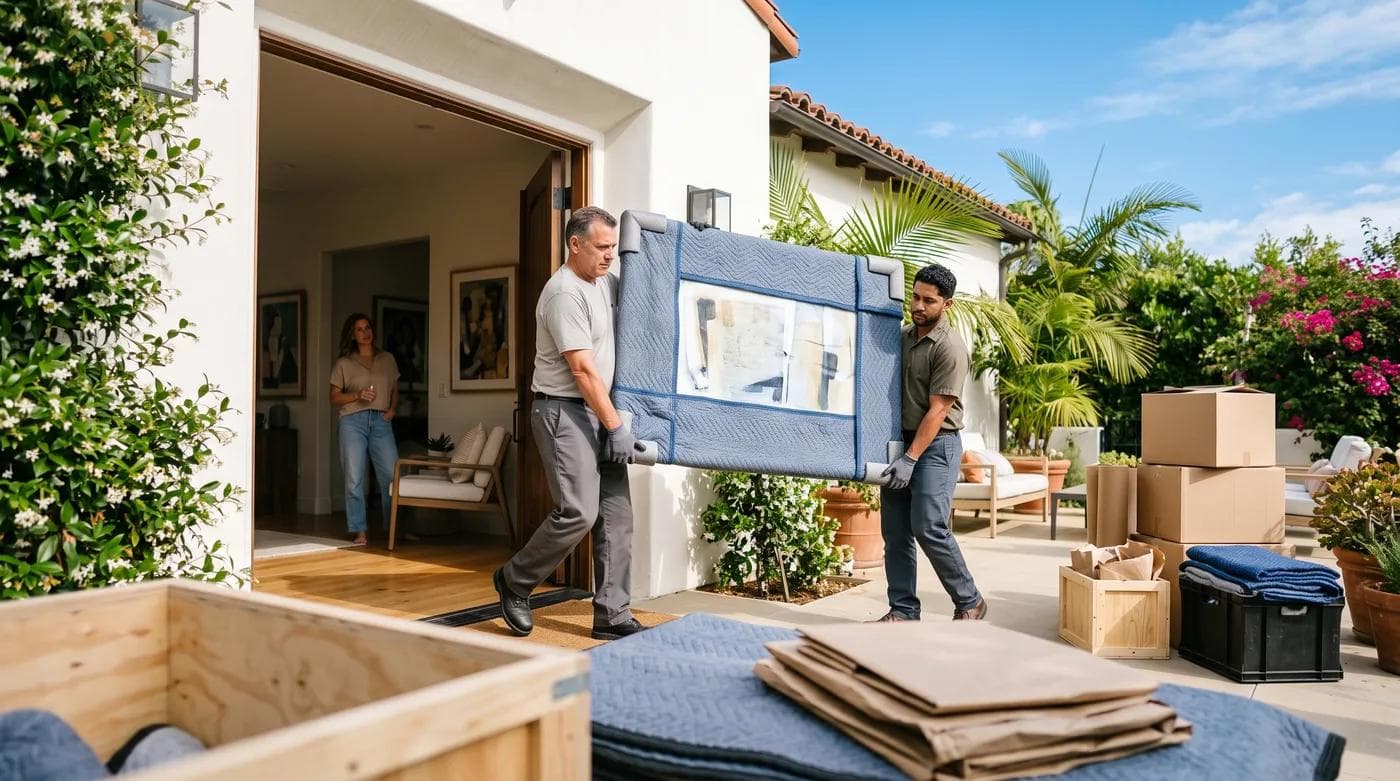

Your kitchen is the hardest room to pack for a move — and it’s where most breakage happens. I’ve packed over 500 kitchens across Los Angeles, and the mistakes are always the same: plates stacked flat instead of on edge, glasses tossed in with a single sheet of paper, appliances unplugged and thrown into a box without wrapping. This guide to packing a kitchen for moving covers everything from plates to pantry items, in the order you should actually pack them.
The key to packing a kitchen efficiently is working in zones and starting early. You don’t need to pack everything in one day — spread it across a week, start with the items you rarely use, and leave the everyday essentials for last. If you want an accurate count of what you’re moving before you start, scan your space with AI Moving — the AI builds a detailed inventory that helps both you and your movers plan.
When to Start Packing Your Kitchen
Start packing your kitchen two weeks before your move date. Not everything at once — in phases. Week two: pack everything you don’t use daily (specialty appliances, serving platters, vases, seasonal items, extra glassware). Week one: pack everything except the essentials you’ll use until moving day (one pot, one pan, a few plates, mugs, utensils). Moving day morning: pack the last box.
This phased approach means you’re never scrambling and you’re never eating takeout for two weeks straight. You can still cook simple meals while most of your kitchen is already boxed up.
Pack a separate “last night / first morning” box with: a pot, a pan, two plates, two mugs, utensils, dish soap, a sponge, paper towels, coffee maker, and your favorite snacks. Label it “OPEN FIRST” and keep it with you — not on the truck. You’ll want coffee before you want to unpack anything else.
Supplies You Need for a Kitchen Pack
A standard LA kitchen (two-bedroom apartment) takes about 6–10 medium boxes, 5–8 pounds of packing paper, one roll of bubble wrap, and a roll and a half of packing tape. Here’s what each material does:
Packing paper is your workhorse — you’ll use it for plates, bowls, cups, and everything in between. Unprinted newsprint works best. Regular newspaper leaves ink on dishes. Budget $15–$20 for a 25-pound bundle.
Bubble wrap is for fragile-only items: wine glasses, crystal, thin ceramics, anything irreplaceable. Don’t waste it on sturdy plates or mugs — packing paper handles those fine.
Medium boxes only. Never use large boxes for kitchen items. A large box filled with dishes weighs 70–80 pounds, is dangerous to carry, and the weight crushes whatever’s on the bottom. Medium boxes (18″ x 18″ x 16″) keep each box under 50 pounds.
Dish boxes with cell dividers are ideal for glasses and stemware but not required. If you can find them at your local supply store, buy 2–3. Otherwise, standard medium boxes with proper wrapping work fine.
Packing Plates and Bowls
Plates are the item people pack wrong most often. The mistake: stacking them flat. A flat stack puts all impact force on the bottom plate. One bump during transit and the whole stack cracks.
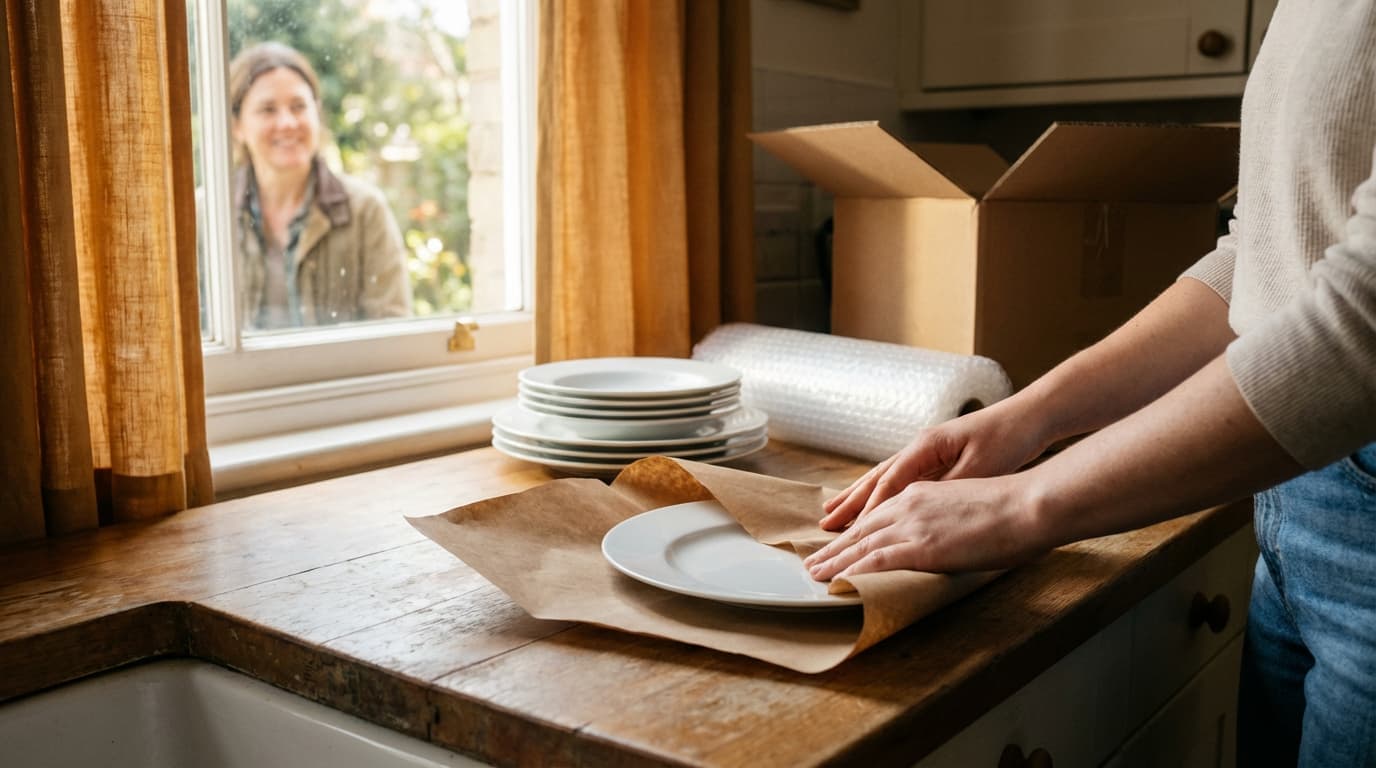
Pack plates vertically — on their edge, like records in a crate. Wrap each plate individually in one sheet of packing paper (two sheets for dinner plates). Fold the corners over and tuck against the face. Stand wrapped plates on edge in the box with crumpled paper between each one.
Start and finish every box with 2–3 inches of crumpled paper — bottom cushion and top cushion. When the box is full, close it and give it a gentle shake. If anything shifts or rattles, open it back up and add more paper. Label the box “FRAGILE — Plates — Kitchen” on two sides and the top.
Bowls get wrapped individually, then nested in groups of 3–4. Stand the nested stacks vertically in the box, same as plates. Mixing bowls and salad bowls go in their own box — they’re bulky and eat space fast.
Never wrap multiple dishes in the same sheet of paper. They rub against each other through the paper and chip. One item, one wrap. Always. This is the single most common packing mistake in kitchens.
Packing Glasses and Mugs
Every glass needs individual wrapping — no exceptions, even for thick pint glasses. The process: stuff a small ball of crumpled paper inside the glass, then roll the glass in a sheet of packing paper, tuck the excess into the opening, and secure with tape if needed. Stand wrapped glasses upright in the box, opening facing up.
Wine Glasses and Stemware
Stems break because people don’t protect them separately. Wrap the stem and base with a strip of bubble wrap first, then wrap the entire glass in packing paper. If you have cell dividers — one glass per cell, stem pointing down. Without dividers, pack each wrapped glass upright with crumpled paper filling every gap. For especially valuable crystal or antique stemware, white glove moving services include professional packing for fragile items.
Mugs
Same technique as glasses: paper ball inside, full wrap outside, standing upright in the box. Don’t hang mugs by their handles — handles are the first thing to snap during transit. Wrap the handle as part of the full wrap and position the mug so the handle isn’t taking any pressure from neighboring items.
If you’re packing during an LA summer in an apartment without AC, double-tape the bottom of every dish box. Tape adhesive weakens in heat, and I’ve seen boxes give out from the bottom in trucks sitting in direct sun. It takes ten seconds and prevents a disaster.
Packing Small Appliances
Toaster, blender, coffee maker, Instant Pot, stand mixer — every kitchen has a collection of small appliances that are awkward to pack.
If you still have the original box — use it. The manufacturer designed that packaging specifically for the item. If not, wrap the appliance in packing paper or bubble wrap, paying extra attention to any glass components (blender jars, coffee carafes). Detach anything removable (blades, lids, attachments) and wrap those separately.
Wrap cords around the appliance and secure with a rubber band or tape — loose cords get tangled and caught. Place heavier appliances at the bottom of the box, lighter ones on top. Fill gaps with crumpled paper or kitchen towels (towels work fine as padding for appliances — unlike dishes, appliances don’t chip from soft contact).
Knives: Never pack loose knives in a box. Use blade guards if you have them. If not, wrap each knife in several layers of packing paper, secure with tape, and clearly write “KNIVES” on the outside of the wrapping. Or bundle them in a kitchen towel rolled tight and taped. Your movers — and your future self reaching into a box — will thank you.
Packing Pantry and Refrigerator Items
Most people overthink this. Here’s the simple rule: if it’s open and perishable, toss it. If it’s sealed and non-perishable, pack it. Moving an open jar of mayo or a half-used bag of flour across town isn’t worth the mess or the weight.
For sealed pantry items (canned goods, spices, cooking oils, rice, pasta): pack in small boxes. Canned goods are heavy — a medium box of cans can easily hit 50+ pounds. Use small boxes and don’t overfill.
For refrigerator and freezer: Use a cooler with ice packs for anything you’re keeping. Plan to use up perishables in the week before your move. Defrost the freezer 24 hours before moving day — a leaking freezer in a moving truck ruins everything below it.
For local moves in LA, a cooler keeps refrigerator items cold for the few hours of transit. For longer moves, it’s usually not worth transporting perishables — donate them to a neighbor or a local food bank.
AI Moving’s video scan captures your full kitchen inventory — including appliances, dishes, and pantry items. When movers see exactly what they’re moving, they bring the right number of boxes, the right amount of packing material, and the right size truck. No scrambling for extra supplies on moving day.
The Packing Order: What Goes First, What Goes Last
Follow this order and you’ll be able to cook simple meals until the night before your move:
Two weeks out: Specialty appliances (waffle maker, food processor, stand mixer), serving dishes, vases, wine glasses, holiday dishes, anything you haven’t used in the past month.
One week out: Most plates, bowls, glasses, extra utensils, baking supplies, pantry overflow, cookbooks, decorative items.
Two days out: Everything except your “last night / first morning” box. Clean the fridge, defrost the freezer, take out trash.
Moving morning: Pack the final box — coffee maker, last mugs, last utensils, dish soap, sponge. Label it “OPEN FIRST” and keep it with you.
Common Kitchen Packing Mistakes
Using boxes that are too large. This is the number one mistake. Large boxes + heavy kitchen items = dropped boxes and broken dishes.
Skipping the cushion layers. Every box needs 2–3 inches of crumpled paper on the bottom and top. The bottom of the box hits the truck bed, the dolly, the floor. Without cushioning, the first item in absorbs every impact.
Packing dirty dishes. Wash everything before you pack it. Unpacking dirty dishes at your new place — when your kitchen isn’t set up yet — is miserable. Take the 30 minutes now.
Forgetting to empty the garbage disposal. Run it clean before you leave. Same for the dishwasher — run an empty cycle. You don’t want standing water or food residue in appliances that will sit in a hot truck.
Not labeling clearly enough. “Kitchen” isn’t enough. Write “FRAGILE — Wine Glasses — Kitchen” or “Pantry — Cans — Heavy.” Movers stack based on labels. If they don’t know it’s fragile, heavy boxes go on top of it.
Professional kitchen packing in Los Angeles typically costs $150–$300 depending on kitchen size. Many movers on the AI Moving platform include basic packing materials (blankets, shrink wrap, tape) in their hourly rate. Full-service packing adds $200–$500 for a full apartment.
Frequently Asked Questions
Q: How many boxes do I need to pack a kitchen?
A: A studio or one-bedroom kitchen typically needs 4–6 medium boxes. A two-bedroom kitchen needs 6–10. A large family kitchen can require 12–15+. The count depends on how many dishes, appliances, and pantry items you have — an AI video scan gives you an accurate count before you buy supplies.
Q: Should I pack plates vertically or flat?
A: Always vertically, on their edge. Vertical packing distributes impact force across the edge of the plate instead of concentrating it on the flat face. Think of it like books on a shelf — they’re stronger standing up.
Q: Can I use towels and clothing to wrap dishes?
A: For appliances, yes — soft items like towels work as padding. For dishes and glasses, no. Towels compress under weight and stop protecting after the first bump. Use packing paper for anything breakable.
Q: How do I pack sharp knives safely?
A: Use blade guards if you have them. Otherwise, wrap each knife in several layers of packing paper and tape securely. Or roll them in a thick kitchen towel, tape it tight, and label the bundle clearly. Never pack loose knives.
Q: What should I do with open food items?
A: Toss anything open and perishable. Sealed, non-perishable items (canned goods, spices, cooking oils) can be packed in small boxes. Use up refrigerator items in the week before your move or donate them.
Pack Smart, Move Easy
Your kitchen has more items per square foot than any other room in your home. But with the right supplies, the right order, and a little patience, it’s completely manageable. Start early, work in zones, wrap everything individually, and never use a box you can’t comfortably lift.
Ready to plan the rest of your move? Scan your space with AI Moving and get an accurate inventory in minutes. Vetted LA movers will send you quotes based on exactly what you’re moving. Check our pricing or get started with a free AI estimate.